
Technical overview.
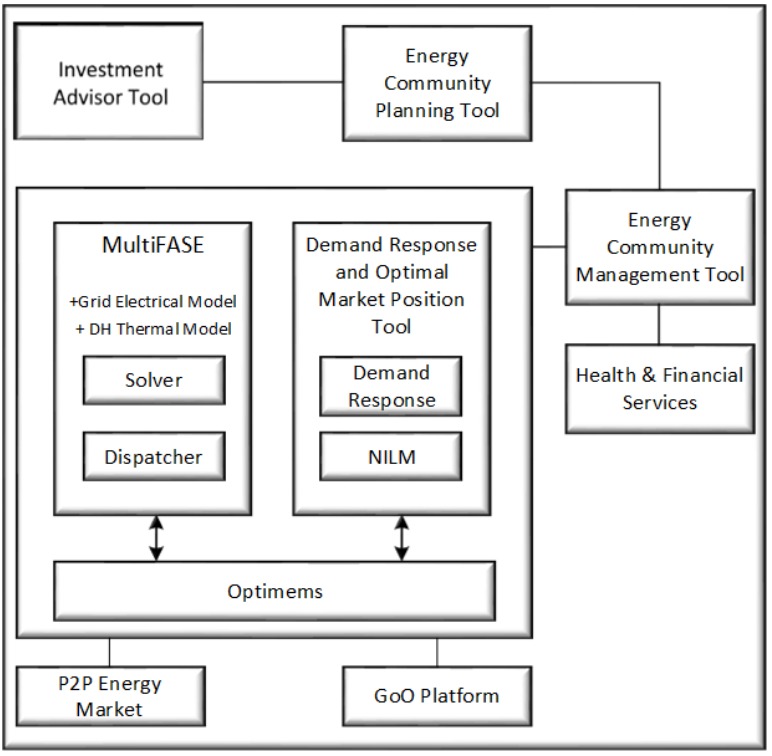
The collaboration between the tools within the COMMUNITAS project fosters a holistic approach to microgrid management. By integrating insights from grid analysis, user behaviour, and optimisation algorithms, the collaboration aims to optimise microgrid operations, enhance grid stability, promote citizen engagement, and ensure the long-term resilience and sustainability of energy systems.
Central to this collaboration is the iterative exchange of information and insights between the tools. MultiFASE performs real-time power flow analysis and state estimation, identifying nodes or areas within the grid that may exhibit instability or require optimisation. This information is relayed to OptiMEMS, enriching its optimisation algorithms with additional constraints derived from the grid’s state estimation. By integrating MultiFASE’s findings, OptiMEMS can proactively address potential grid instabilities or bottlenecks, ensuring that microgrid operations are optimised while maintaining grid stability and reliability. Simultaneously, the Demand Response tool employs Non-Intrusive Load Monitoring (NILM) techniques to extract appliance usage patterns from user consumption data. Leveraging these patterns, the Demand Response tool identifies opportunities for demand response participation, empowering citizens to modify their energy consumption behaviours and actively engage in energy markets.
The recommendations provided by the Demand Response tool are then incorporated into the load forecasting module of OptiMEMS, appropriately modifying each user’s load curve. This integration ensures that user flexibility potential is considered alongside grid constraints in the optimisation framework, resulting in more accurate load forecasts and optimised microgrid operations. Furthermore, to enhance collaboration, the tools can exchange feedback loops, where the effectiveness of Demand Response recommendations provided to users is evaluated based on actual response and consumption patterns observed. This feedback loop also informs future recommendations and adjustments to optimisation strategies within OptiMEMS, enabling continuous improvement and adaptation to evolving grid conditions and user behaviours. More information on the tools below.
Click on any of the topics below to learn more.
01
Investment Advisor Tool
Strategic deployment plans, payback period, NPV, CO₂ reduction — tailored per household and per community.
Investment Advisor Tool
Strategic deployment plans, payback period, NPV, CO₂ reduction — tailored per household and per community.The Investment Advisor Tool systematically evaluates sustainable investment options within the Energy Community (EC) at both the building and community levels. It provides strategic deployment plans, estimated expenses, and anticipated outcomes — all aimed at achieving financial and energy-related economies for users and the EC as a whole.
The platform addresses the need to enhance community performance by promoting energy efficiency. Recognising that different communities are at varying stages of implementation, it offers customised solutions: one community may need to improve household insulation, while another may need to electrify cooking or heating systems to maximise local generation benefits.
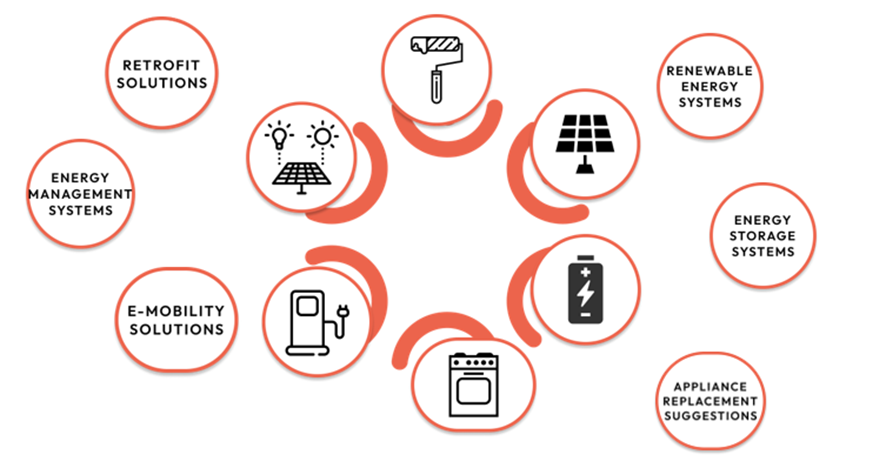
Designed with accessibility in mind, a baseline survey simulates household scenarios and aggregates data at community level — producing tailored plans that are accessible to all citizens, regardless of energy literacy. At the end of this process, users receive deployment plans with key technical and financial indicators: initial investment, payback period, net present value (NPV), cost savings, and CO₂ reduction.
The platform involves two main actors: EC members and the EC manager. Personalised dashboards let members see their individual investment plans. If enough members show interest in a specific investment — better insulation, rooftop PV, etc. — the EC manager is notified to secure better quotes through bulk orders. The manager dashboard offers community-level insights to aggregate and analyse data, and to make informed decisions.
02
Energy Community Planning Tool
Simulates scenarios in energy balance, supply cost, and emissions to find the optimal community configuration.
Energy Community Planning Tool
Simulates scenarios in energy balance, supply cost, and emissions to find the optimal community configuration.The Energy Community Planning Tool (ECPT) simulates different scenarios in terms of energy balances, energy supply costs, and GHG emissions for an energy community — helping citizens or a managing stakeholder determine the best option as they plan a new EC. The tool capitalises on RINA’s experience with another tool, initially developed in the MUSE GRIDS project.
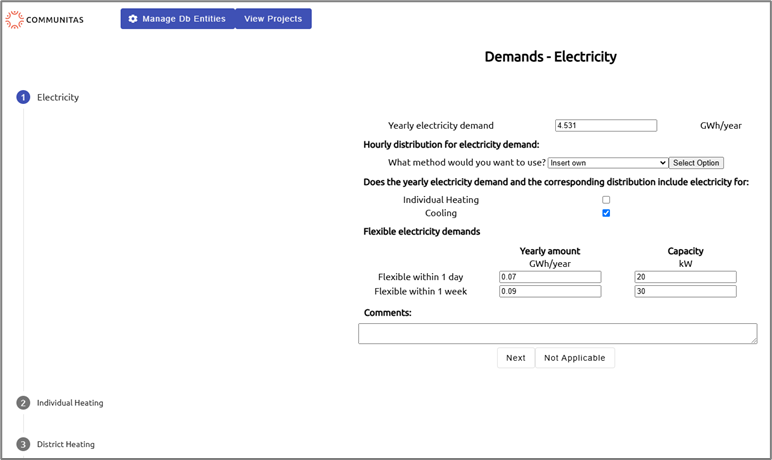
The user interface lets the end-user provide inputs for the baseline scenario and for scenarios to be simulated for optimisation purposes:
- Electricity demand for buildings;
- Electricity demand for vehicles;
- Electricity production for renewable power plants;
- Electricity production for cogeneration;
- Fuel consumption for heating and for vehicles;
- Number of buildings and end users in the energy community;
- Minimum and maximum size of renewable plants and storage systems for optimisation;
- Desired optimisation objective: minimum GHG emissions, fossil-energy use, supply cost, or investment.
Inputs should be provided at hourly resolution; if only annual values are available, distribution algorithms apply automatically.
The ECPT outputs annual and hourly energy demand/supply, GHG emissions, supply costs, and the optimal configuration of renewable plants (PV, wind, solar thermal, biomass, district heating…) and storage that meets the chosen optimisation criterion. To do so it runs multiple simulations, varying plant and storage sizes until the best scenario is found.
03
Energy Community Management Tool
An aggregator of energy data, presenting information at both household and community levels.
Energy Community Management Tool
An aggregator of energy data, presenting information at both household and community levels.This platform aggregates energy data and presents it at both household and community levels. Designed to integrate members and visually present results, it makes the value of metering plain to see.
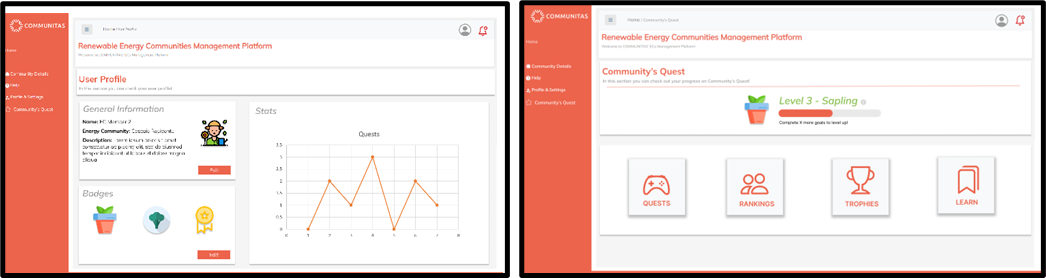
For community members
- Monitor your energy — track self-consumption, production, and grid usage; see your self-sufficiency rate.
- Optimise usage — compare your consumption with the community and tune your assets.
- Save money — understand your energy usage to lower your bills.
- Stay informed — visualise production, distribution, and sharing coefficients.
- Direct support — contact the EC manager directly for any issues.
- Eco-challenges — compete with peers and earn rewards.
For EC managers
- Comprehensive oversight — full view of the community, asset availability, and production levels.
- Efficient management — visual dashboard to add or remove members and assets.
- Performance tracking — consumption, production, self-consumption, and self-sufficiency.
- Financial insights — compare actual bills with projections to verify savings.
- Real-time updates — centralise information and access live data to address issues quickly.

The platform supports managers in overseeing community performance and helps members maximise their efficiency — transforming energy management for a sustainable future.
04
Demand Response Tool
NILM-driven appliance disaggregation feeding a genetic-algorithm scheduler that surfaces 15-minute consumption recommendations.
Demand Response Tool
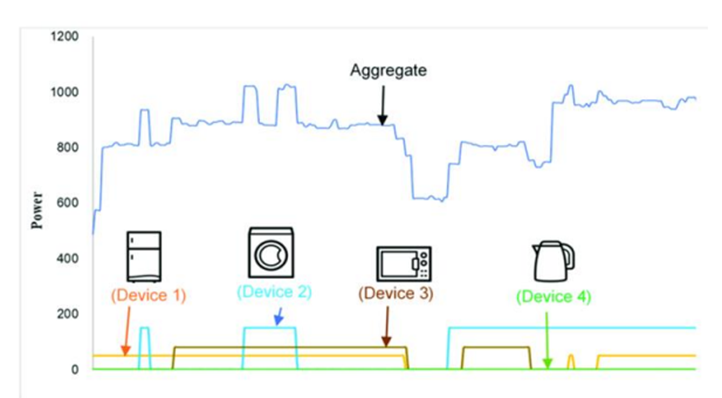
NILM-driven appliance disaggregation feeding a genetic-algorithm scheduler that surfaces 15-minute consumption recommendations.Non-Intrusive Load Monitoring (NILM) estimates energy consumption at the appliance level. By monitoring only the household total — whether active power or consumed energy — one can obtain the disaggregated individual consumption of each connected device in a home, shop, or industrial site.
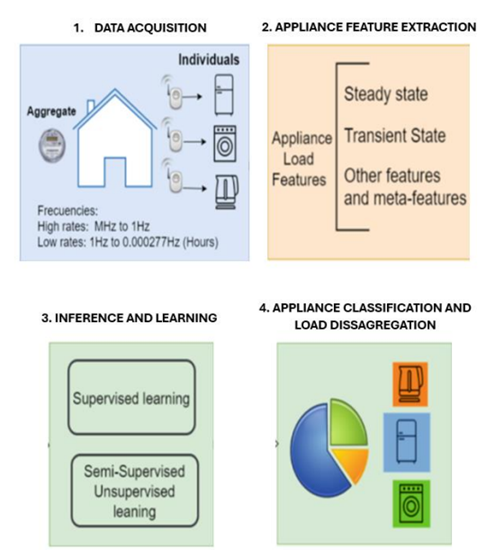
Data acquisition happens through household meters that provide electrical-consumption magnitudes. Those values are processed into new variables that allow a deeper understanding of consumption. Models then learn from historical data and infer on new data, disaggregating household devices.
By combining public datasets with data from project pilots, generalised models are created using supervised machine learning. Each appliance has its own generalised model that can be applied in any household with total-consumption data. In other words, models are trained with Big Data from many different houses, allowing them to extract general patterns of activation and predict connections across contexts.
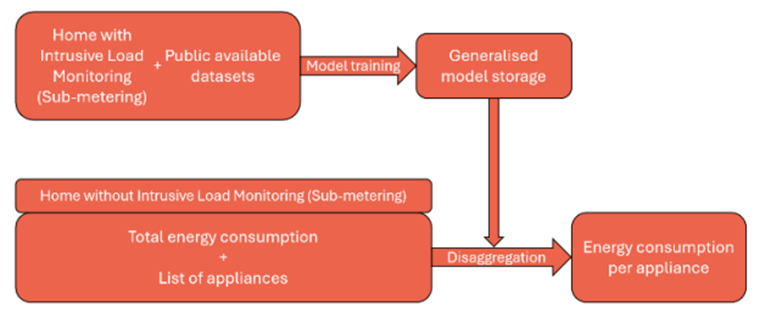

Once models are trained, validated, and saved, applying them to a brand-new household requires only the total energy-consumption series and the list of connected appliances.
From NILM to Demand Response
The data retrieved from NILM can be used to explore consumption patterns and optimise them. Building on NILM, a Demand Response tool was developed to explore the energy flexibility of certain user-defined loads.
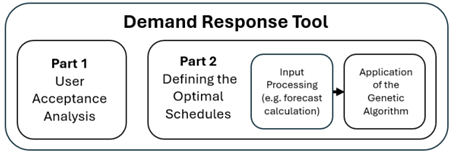
The Demand Response Tool runs in two parts. In the first, day-t consumption is analysed: how many of the day-t-1 recommendations the user accepted (level of acceptance), and how much money would have been saved had they all been followed (educational view). In the second part, the energy flexibility of specific user-defined loads is assessed and recommendations for day t+1 are generated.
The second part is itself two-stage. Stage one processes inputs:
- Forecast of non-flexible load operation for day t+1
- Solar panel generation forecast for day t+1
- Tariffs in force
- Contracted power capacity
- Flexible loads to optimise for day t+1
- Working conditions for day t+1
Stage two runs a genetic-algorithm-assisted optimisation across 15-minute intervals to determine optimal load activation times that maximise savings. For example, it may recommend running the dishwasher at 06:30 and the washing machine at 22:30 — for a total cost of €3.50.
05
MultiFASE
State estimation for multi-energy systems — electrical grid & district heating, real-time, noise-tolerant.
MultiFASE
State estimation for multi-energy systems — electrical grid & district heating, real-time, noise-tolerant.MultiFASE is designed for state estimation of multi-energy systems using real-time measurements. Two modules are available today: Electrical Grid State Estimation and District Heating State Estimation. Its primary objective is to compute the multi-energy states (voltage for the electrical grid; temperature, pressure, and mass flow rate for district heating) at every node of the network, while filtering out measurement errors and noise.
Electrical Grid State Estimation
States here include voltage magnitudes & angles at all buses and currents at all lines. Measurements include power flows on lines, power consumption at consumer buses, and the voltage at the slack bus.
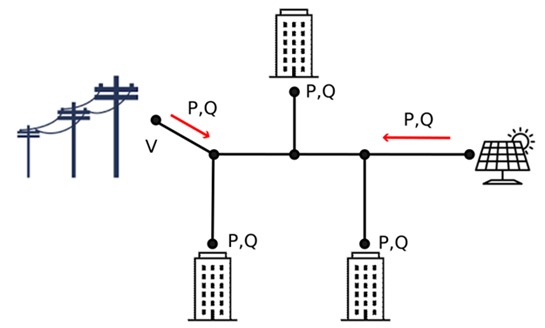
In modern distribution systems — especially those with distributed generation — state estimation is critical for:
- Real-time monitoring — understand current conditions and respond to changes quickly.
- Reliability & stability — detect anomalies and potential failures early.
- Renewables integration — manage variable outputs while keeping operation stable.
- Optimised power flow — reduce losses and improve efficiency by knowing the real grid state.
The COMMUNITAS network requirements for the Electrical Grid Module are: low-voltage network topology, accuracy information (margin of error / standard error) per measurement device, and nominal states for the variables.
District Heating State Estimation
The goal is the same — recover all states from a set of noisy measurements — but the states are temperatures and pressures at nodes plus mass flow at every pipe. Measurements include selected node temperatures and pressures, end-node heat consumption and generation, and ambient temperature.
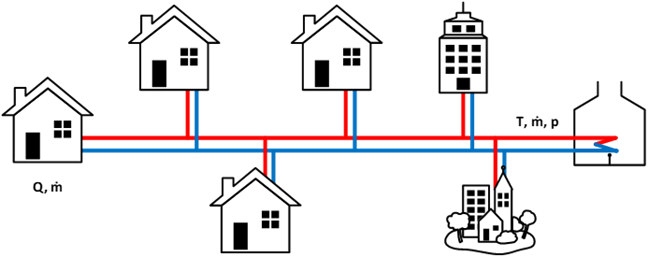
Improved real-time monitoring informs both management and operation of the network, and higher temporal & spatial granularity helps optimise district heating production processes too. Network requirements: topology, per-device accuracy information, and nominal states for each subsystem (electrical and heating) under standard operating conditions.
06
OptiMEMS
Forecasting + scheduling + real-time validation for microgrids and Virtual Power Plants — grid-connected or islanded.
OptiMEMS
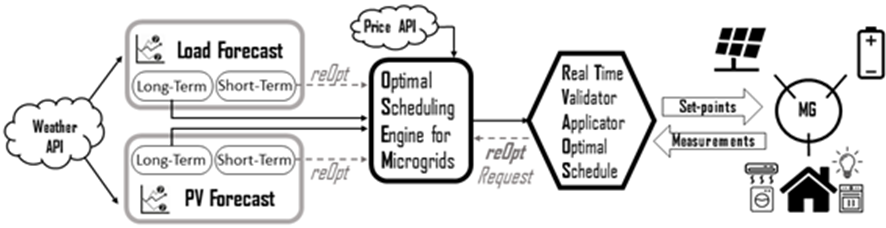
Forecasting + scheduling + real-time validation for microgrids and Virtual Power Plants — grid-connected or islanded.The CERTH team has developed and tested an innovative scheduling framework called OptiMEMS — the Optimised Energy Management System — designed for microgrids (MGs) and Virtual Power Plants (VPPs). It combines forecasting, optimisation, and real-time supervision to deliver efficient and adaptable energy management. Its flexible architecture supports both grid-connected and islanded modes.
-
Forecasting tools
- Machine-learning-based forecasting tool for load consumption.
- Hybrid deterministic / stochastic forecasting tool for PV generation.
-
Optimal scheduling engine for microgrids
- Solves a modified Unit Commitment problem tailored for MGs and VPPs in either grid-connected or islanded mode.
- Produces day-ahead schedules that pursue cost minimisation or resilience.
- Determines optimal scheduling of generation units within operating constraints.
- Determines optimal scheduling of storage units, dispatching set points for their operation.
-
Real-time validator-applicator
- Validates the schedule application.
- Triggers recalculation when deviations occur between real and forecasted energy data.
OptiMEMS has been successfully applied across a variety of cases — residential VPPs, EV-based VPPs, and dynamic VPPs supporting widely-used standards such as OpenADR. It is designed to integrate Distributed Energy Resources (DERs): Renewable Energy Sources (RES), Energy Storage Systems (ESSs), and grid-interaction points using the Passive Sign Convention.
Data requirements
- Minimum of 3 months of historical consumption measurements (consumption forecasting training).
- Minimum of 3 months of historical PV generation measurements or the technical characteristics of the PV panels for the stochastic forecaster.
- Real-time energy consumption and generation measurements.
- Real-time weather data.
- Real-time energy price data.
07
P2P Energy Market — WattSwap
Blockchain-based peer-to-peer energy trading: neighbours buy and sell, no central authority required.
P2P Energy Market — WattSwap
Blockchain-based peer-to-peer energy trading: neighbours buy and sell, no central authority required.Peer-to-peer energy trading is a new approach to energy systems that lets individuals in a local community buy and sell energy from each other. When a household has extra energy from solar panels — instead of sending the surplus back to the grid — they can sell that excess to neighbours who need it. These trades benefit both the seller (who earn revenue) and the buyer (who buys cheaper, local, sustainable energy). P2P trading operates alongside traditional energy systems, providing a flexible, decentralised way to manage demand.
Blockchain distributes control across all participants instead of relying on a central authority — turning passive consumers into active participants in the energy market.
In conventional systems, especially for things like energy, we rely on a central authority — utilities or grid operators — to manage everything: generation, pricing, distribution. Consumers are passive, prices are set by the company, and energy flows in one direction. Blockchain changes that by distributing control across all participants in the network.
How WattSwap works
WattSwap is a blockchain P2P energy-trading platform. To use it, participants connect a blockchain wallet that holds value (like cryptocurrencies) and signs transactions expressing how they want to use the system.
- Producers — households with solar panels register their wallet and join the platform; excess solar energy is sold at the market price to neighbours.
- Buyers — consumers register their wallet and indicate when and at what price they want to buy energy. For example: weekday lunchtime energy at half the typical utility price, or higher to support local green energy.
- Matching — WattSwap matches bids with available excess solar production in real time.
Local energy communities or municipalities can also use WattSwap to reward sustainable behaviour. Households that share the most energy or use more local sustainable sources can earn blockchain-based NFTs — collectable artworks that can be traded, displayed, or used to unlock exclusive discounts on local services and entry to local events.
P2P energy trading isn’t just about saving money — it’s about rethinking the relationship between consumers, producers, and energy. People become active participants in the energy market rather than passive consumers.